 Photo: Wikimedia contributors · See source
Kanchanaburi, Erawan & Remembrance
Travel from Nakhon Pathom through Kanchanaburi, Hellfire Pass and Erawan on a four-day western loop.
- Allow
- 4 days
- Route
- 366 km
- Drive time
- 5 hr 21 min
- Stops
- 6
Kanchanaburi combines a beautiful river landscape with the history of forced labour on the Burma–Thailand Railway. Begin at the war cemetery and an interpretive museum before the bridge, then give Hellfire Pass the time and seriousness of a memorial landscape rather than treating it as adventure scenery.
Sai Yok and Erawan turn the final days toward forest and water. Conditions change with fire, rain and park management, so check the Department of National Parks before leaving, wear proper footwear and accept closure without substituting an unsigned trail or river crossing.
The road, in one glance
Pinch or scroll with Ctrl / ⌘ to zoom
Drawing the route…
The route earns
its distance
Each pin is selected as a place to do something—not merely proof that you passed through.
- 01Nakhon Pathom
- 02Kanchanaburi War Cemetery
- 03Bridge on the River Kwae
- 04Hellfire Pass
- 05Sai Yok Noi
- 06Erawan National Park
 Photo: Wikimedia contributors · See source
Nakhon Pathom
The great chedi and a western road junction create a measured start beyond Bangkok.
Nakhon Pathom is a city (thesaban nakhon) in central Thailand, the capital of Nakhon Pathom province. One of the most important landmarks is the giant Phra Pathommachedi. The city is also home to Thailand's only Bhikkhuni temple Wat Song Thammakanlayani (วัดทรงธรรมกัลยาณี), which is also open to women from abroad.
 Photo: Wikimedia contributors · See source
Kanchanaburi War Cemetery
Rows of Commonwealth graves make the human cost of the railway immediate.
The Kanchanaburi War Cemetery (known locally as the Don-Rak War Cemetery) is the main prisoner of war (POW) cemetery for victims of Japanese imprisonment while building the Burma Railway. It is on the main road, Saeng Chuto Road, through the town of Kanchanaburi, Thailand, adjacent to an older Chinese cemetery. The cemetery contains 6,982 graves of British, Australian and Dutch prisoners of war, of whom 6,858 have been identified.
 Photo: Wikimedia contributors · See source
Bridge on the River Kwae
The surviving railway bridge is both a working structure and a heavily mythologized war site.
The Bridge on the River Kwai is a 1957 epic war film directed by David Lean and based on the novel The Bridge over the River Kwai, written by Pierre Boulle. Boulle's novel and the film's screenplay are fictional; they use the construction of the Burma Railway in 1942–1943 as historical setting. It stars William Holden, Alec Guinness, and Jack Hawkins, with Sessue Hayakawa, James Donald, Ann Sears, and Geoffrey Horne in supporting roles.
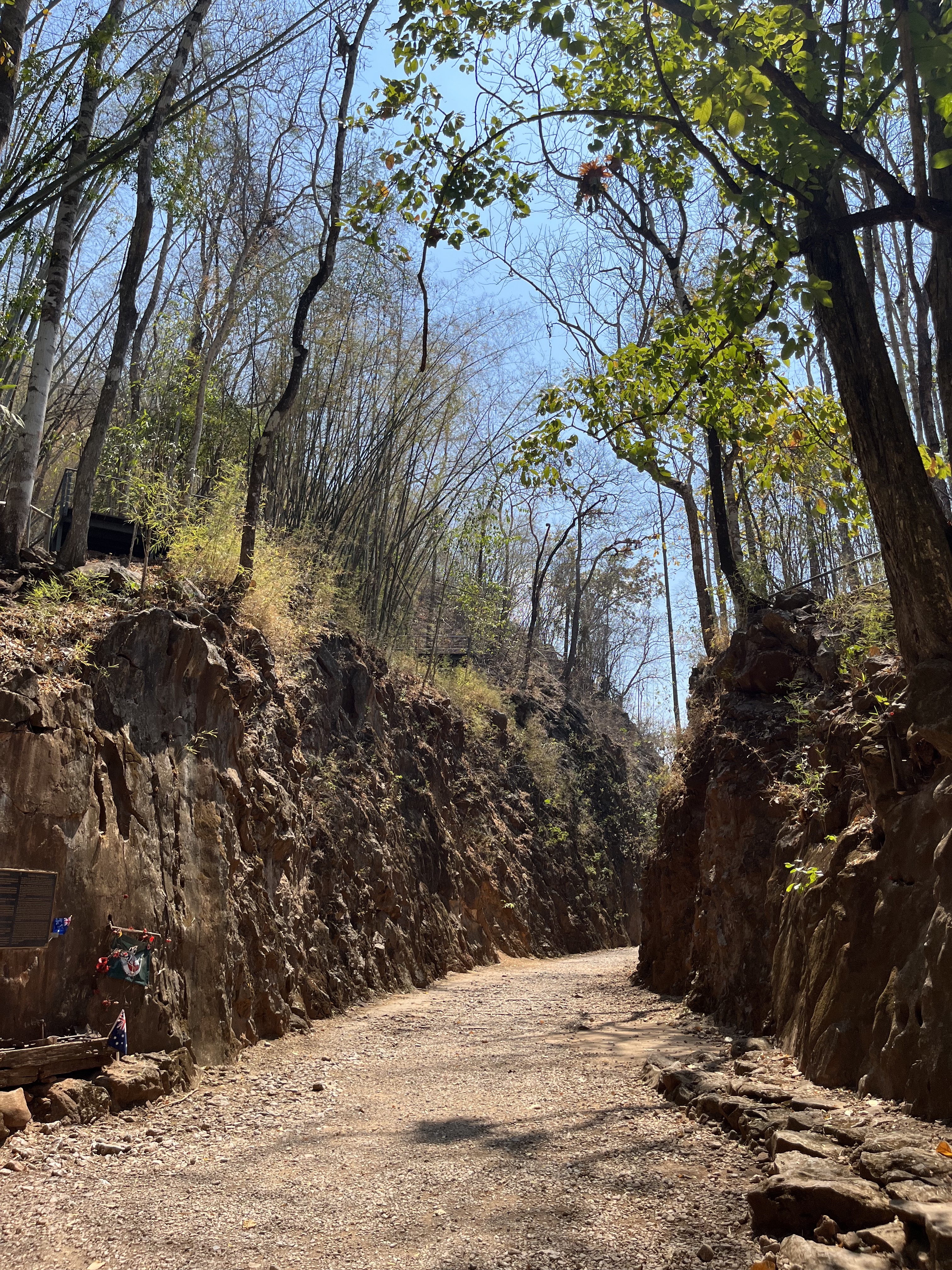 Photo: Wikimedia contributors · See source
Hellfire Pass
A hand-cut railway section and interpretive trail commemorate prisoners and Asian rōmusha.
Hellfire Pass (Thai: ช่องเขาขาด, known by the Japanese as Konyu Cutting) is the name of a railway cutting on the former Burma Railway ("Death Railway") in Thailand, which was built with forced labour during World War II. More than 250,000 Southeast Asian civilians and 12,000 Allied soldiers built the railway line, including Hellfire Pass.
 Photo: Wikimedia contributors · See source
Sai Yok Noi
A compact waterfall and railway-side stop break the return east through the Kwae Noi valley.
Sai Yok National Park (Thai: อุทยานแห่งชาติไทรโยค) is a national park in Sai Yok district, Kanchanaburi Province, Thailand, near the town Nam Tok Sai Yok Noi. The park, home to mountains, waterfalls and caves, is part of the Western Forest Complex protected area. In 1978, the Russian roulette scenes of the film The Deer Hunter were filmed in the park.
Photo: Wikimedia contributors · See sourceErawan National Park
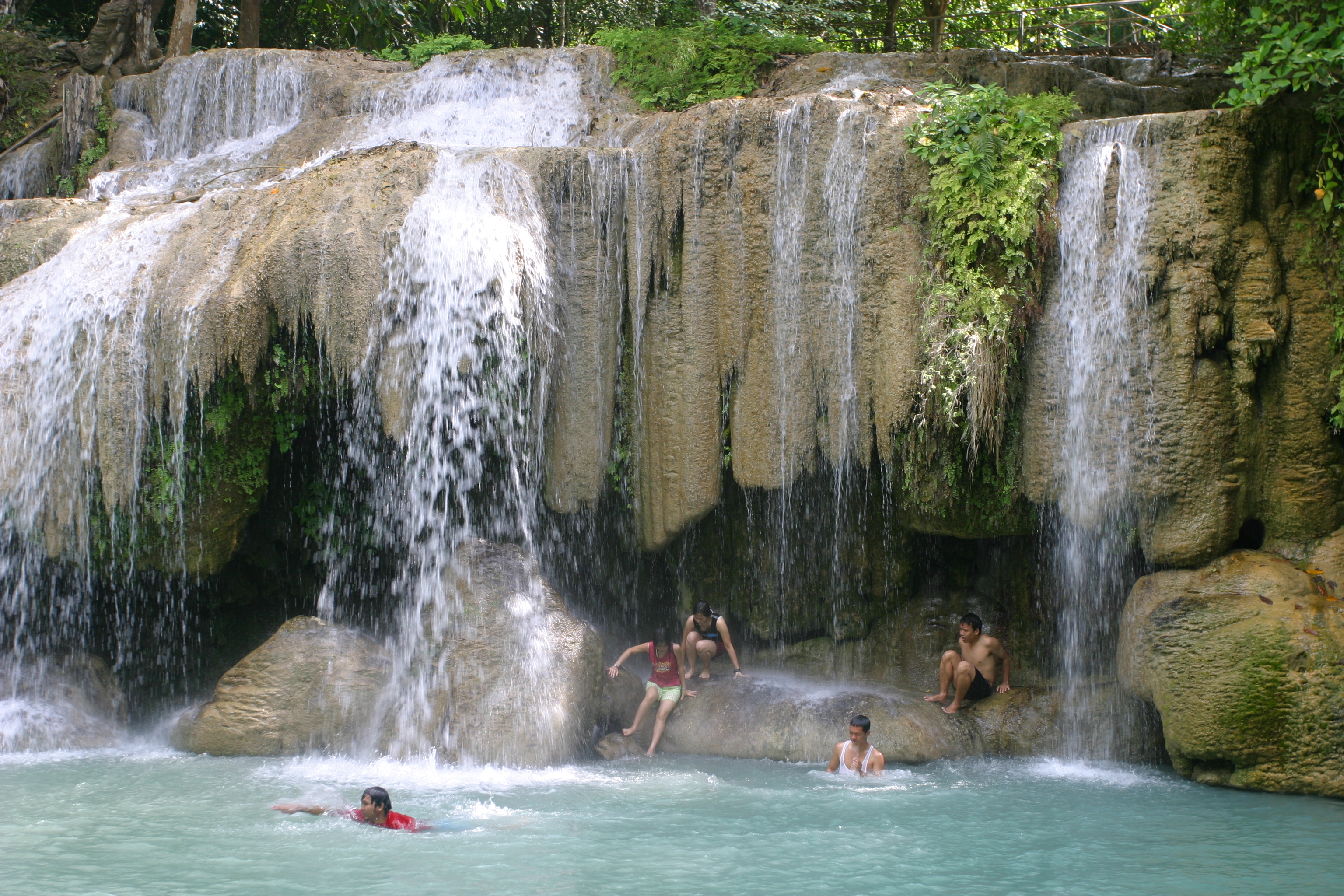
Seven limestone waterfall levels climb through forest above the park entrance.
Erawan National Park (Thai: อุทยานแห่งชาติเอราวัณ) is a protected area in Western Thailand, in the Tenasserim Hills of Kanchanaburi Province. Founded in 1975, it was the 12th national park of Thailand.
Drive the conditions,
not the itinerary.
Travel only in daylight beyond Kanchanaburi, keep the railway history respectful and check Erawan and Sai Yok status directly. Wet limestone, wildlife and mountain bends demand a conservative pace.
Checked against
the people who run it
Distances and driving times are planning estimates. Conditions, closures, ferries, permits and park rules can change, so check the linked official guidance before setting out.